


For many students, mathematics is often seen as one of the most challenging subjects in school. It is common to hear statements such as, “I’m not good at math” or “Mathematics is only for smart students.” Over time, these beliefs become deeply rooted, shaping the way students approach the subject long before they encounter more advanced concepts.
But is mathematics truly difficult, or is the challenge rooted in the way it is taught?
According to Ms. Linawati Liauw, author of Cerdas Matematika, every student has the ability to learn mathematics. The issue is not that mathematics is inherently reserved for a select group of students. Rather, the difficulty often arises when learning focuses solely on transferring knowledge instead of engaging students in the process of discovery.
When mathematics is reduced to memorizing formulas and applying procedures, students may complete exercises without fully understanding the ideas behind them. As a result, mathematics can feel abstract, complicated, and disconnected from everyday life.
Mathematics Is More Than Memorizing Formulas
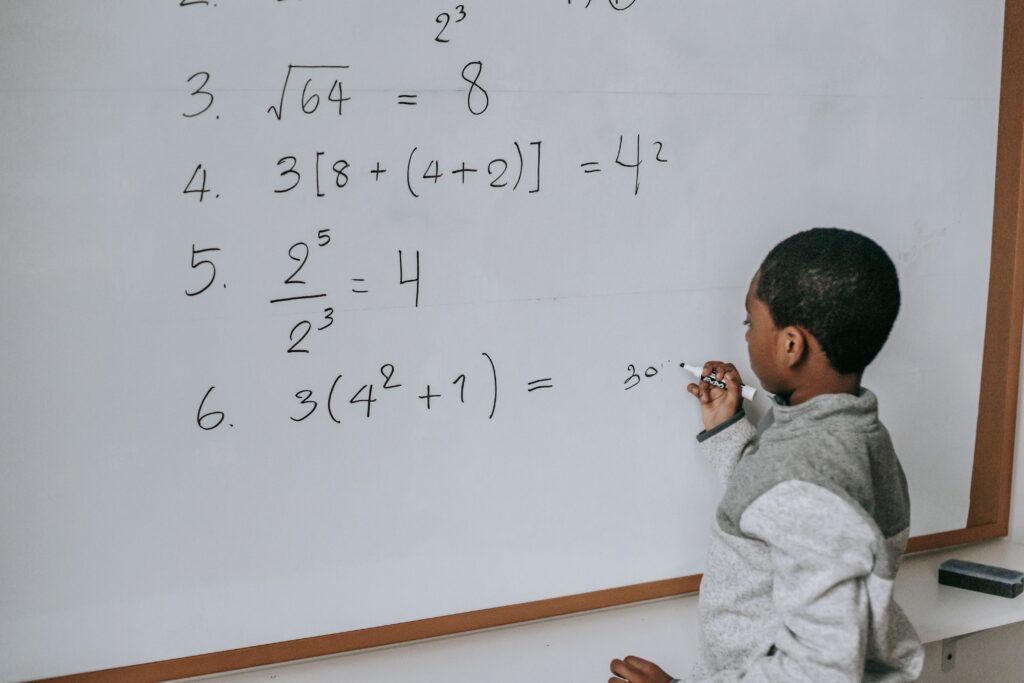
For decades, mathematics education has often been associated with speed and accuracy. Students are expected to remember formulas, solve problems quickly, and produce the correct answer. While these skills are important, they represent only one aspect of mathematics learning.
Meaningful mathematics learning goes beyond memorization. It requires students to think critically, recognize patterns, test ideas, and understand the reasoning behind mathematical concepts.
As Ms. Linawati explains:
“Every student has the ability to learn mathematics.”
The challenge begins when students are treated as passive recipients of information rather than active participants in the learning process.
When lessons focus only on delivering content, students may never have the opportunity to ask questions, explore different strategies, or understand why mathematical rules work the way they do. Without these experiences, mathematics becomes a collection of formulas to memorize rather than a tool for thinking and problem-solving.
Why Do Students Perceive Mathematics as Difficult?
One of the main reasons many students struggle with mathematics is that they are introduced to formulas before they have the opportunity to discover the concepts behind them.
Imagine learning about fractions, geometry, or algebra without first exploring patterns or connecting them to real-life situations. Students may be able to solve exercises mechanically, but they often struggle when faced with unfamiliar problems because they lack conceptual understanding.
Mathematics becomes intimidating when students feel pressured to find the right answer as quickly as possible instead of being encouraged to think, experiment, and learn from mistakes.
This perception can create a cycle:
- Students believe mathematics is difficult.
- They become afraid of making mistakes.
- They participate less in class discussions.
- Their confidence decreases.
- Mathematics feels even more difficult.
Breaking this cycle requires a shift in the way mathematics is experienced in the classroom.
Curiosity: An Essential Part of Mathematics Learning

Children are naturally curious. They ask questions, look for patterns, and try to understand how the world works. In many ways, these habits are the foundation of mathematical thinking.
However, curiosity is not always nurtured in mathematics classrooms.
Many students do not have enough opportunities to:
- Ask, “Why does this formula work?”
- Observe patterns before learning mathematical rules.
- Explore different strategies to solve a problem.
- Explain their thinking to others.
- Discuss alternative solutions with classmates.
Yet these activities are essential for developing genuine mathematical understanding.
Mathematics is not simply about arriving at the correct answer. It is about reasoning, making connections, and understanding relationships between ideas. When curiosity becomes part of the learning process, students begin to see mathematics as something they can explore rather than something they must memorize.
Changing the Learning Experience

If the goal is to help students enjoy mathematics, the solution is not necessarily to change the curriculum or simplify the content. Instead, educators can rethink the learning experience itself.
According to Ms. Linawati, meaningful mathematics learning happens when students are actively involved in constructing knowledge.
Teachers can create classrooms where students are encouraged to:
- Explore mathematical ideas independently.
- Work together to solve problems.
- Discuss different strategies with their peers.
- Present and explain their reasoning.
- Learn from multiple approaches to the same problem.
When students participate actively, mathematics becomes more than a sequence of procedures. It becomes a process of inquiry and discovery.
For example, rather than immediately introducing a formula for calculating area, teachers might invite students to investigate patterns using concrete objects or visual representations. Through exploration and discussion, students can gradually develop their own understanding of the concept before formalizing it with mathematical language.
This approach not only improves conceptual understanding but also helps students build confidence in their ability to think mathematically.
Learning Happens Through Involvement
One of the most powerful ideas in education is captured in the following quote:
“Tell me and I forget. Teach me and I may remember. Involve me and I will learn.”
The same principle applies to mathematics.
Students are more likely to understand mathematical concepts when they actively participate in the learning process. Solving problems, testing ideas, asking questions, and discussing solutions all contribute to deeper understanding.
Meaningful learning happens when students are given the opportunity to think, explore, and discover for themselves.
As educators, the challenge is not simply to teach mathematics but to create experiences that help students develop curiosity, confidence, and a genuine appreciation for the subject.
Building Meaningful Mathematics Learning Experiences

At ASTA, meaningful mathematics learning begins with the belief that every student can learn and enjoy mathematics when given the opportunity to actively engage with ideas.
Through Cerdas Matematika, Ms. Linawati Liauw and the ASTA team aim to create learning experiences that encourage exploration, discussion, and problem-solving. By shifting the focus from memorization to understanding, mathematics becomes more accessible, relevant, and meaningful for learners.
Because mathematics is not only about finding the correct answer—it’s about discovering how to think.